

Goals, Successes, and Pitfalls for Educators in Considering a Transition to Student-Centered Clasrooms
I was in my own little, happy rut. Admittedly, after 15 years of “sage on the stage,” and designing a curriculum that put my dissemination of knowledge at the forefront of my teaching, I encountered an opportunity to radically change my thinking about how and why schools educate students the way that they do. I left my cushy day-in, day-out position- the type where I knew what would be taught, how it would go, and that the end result of the labs, quizzes, and homework would be a unit test. Easy. I could do my job in my sleep, feeling pretty confident in how I did what I did.
I need something to re-energize my teaching. The kids were bored. I was bored. My love for school was fading into the sunset. I made a conscious choice to find that passion again. Little did I know that I was going to embark upon a personal and professional journey that would re-energize my career, challenging my beliefs, approach, curriculum, and base structure that had comprised my career to date. In hindsight, I should have made these changes long ago.
Student-Centered and Personalized Learning. How can students lead? Have a real choice? What makes a task authentic and powerful? These questions still are at the forefront of my thinking. Even after years of study, trial and error, successes, and pitfalls, I can say that I am a completely different educator. It has been a rollercoaster that has opened doors (while slamming others,) caused rolled eyes, and led to comments like “That is so Noah.” It will take a willful suspension of disbelief, but if you are curious about my Edventures, the amazing educators that have helped me along the way, please read on.
What IS Student-Centered Learning?
Create the option for students to fail. It is about student learning, not necessarily what we are teaching. Personalization is for all students.
Where was I going? How do I take the first step? What direction leads where I am going? There is a definite “existential ocean” quality to this type of change. Sometimes, you don’t know, and you are trying not to paddle down.
I choose to focus on stepping away from “Teacher-centric” teaching, leaning instead towards ” Learner-centric” thinking. Looking at what changes have to happen, it really is a large lean.
| Teacher-Centered | Learner-Centered |
| Focus is on instructor | Focus is on both students and instructor |
| Focus is on language forms and structures (what the instructor knows about the language) | Focus is on language use in typical situations (how students will use the language) |
| Instructor talks; students listen | Instructor models; students interact with instructor and one another |
| Students work alone | Students work in pairs, in groups, or alone depending on the purpose of the activity |
| Instructor monitors and corrects every student utterance | Students talk without constant instructor monitoring; instructor provides feedback/correction when questions arise |
| Instructor answers students’ questions about language | Students answer each other’s questions, using instructor as an information resource |
| Instructor chooses topics | Students have some choice of topics |
| Instructor evaluates student learning | Students evaluate their own learning; instructor also evaluates |
| Classroom is quiet | Classroom is often noisy and busy |
Leaning in begins with putting your mind in a place that cedes control of your classroom. Not class culture/ behavioral control, but rather, your curriculum shifts in a way that creates opportunities for students that are normally not provided to them. It is truly restructuring the journey because the destination remains the same. You are not shifting information, pedagogical knowledge, Learning Targets/ Standards, or understanding of your students. It is not starting over but renewing the best of your practices in a way that puts student-driven learning first.
When teachers, administrators, or other staff visit my classroom, they are often confused and thrown a bit off balance. It is often a flurry of activity, with craft materials strewn across tables, labs being run, discussions (of all sorts) being waged, students at assorted tables reading, writing, asking questions, debating, and, as with all classes), goofing off. To be fair (insert your best Letterkenny accent) students often enter my class and take a few weeks to realize that they are being pushed to consider HOW they learn, WHY they are learning, and what skills they bring that allow them to find success at their current level. This level of controlled chaos takes a while to foster, and there are a lot of bewildered looks and raised eyebrows (My favorite is when a student looks at me and says, ” I can actually DO that?”) Formative assessments for no grade, points given for Habits of Work, and encouragement to use their skills and passions as the driving force behind their learning. My mantra (beyond The Four Agreements) is that “School is For You!” This is their education, not mine, and that journey requires respect, nurturing, and challenging each student’s preconceived belief about who they are as learners. When you visit, my litmus test will be how students respond to your questions (yes, talk to them, because they will be honest with you about what is and is not working for them.) My source of pride is when THEY answer with pride and understanding. “I’m on Performance Task X. Or, “This model is my way of expressing X topic, because.” Self-awareness and understanding is vital for students to truly see themselves as learners. Thinking back on your own experiences, when did you feel most confident as a learner? What (or who) made you feel empowered, challenged, and excited?
Realistically, is it worth it? Is this revamping and thought retooling really worth the time and effort? I guess that it depends on your goals and philosophy around learning. What is the most bang for your buck? I take a lot of guidance from the Hattie Barometer of Learning, from “Visible Learning”
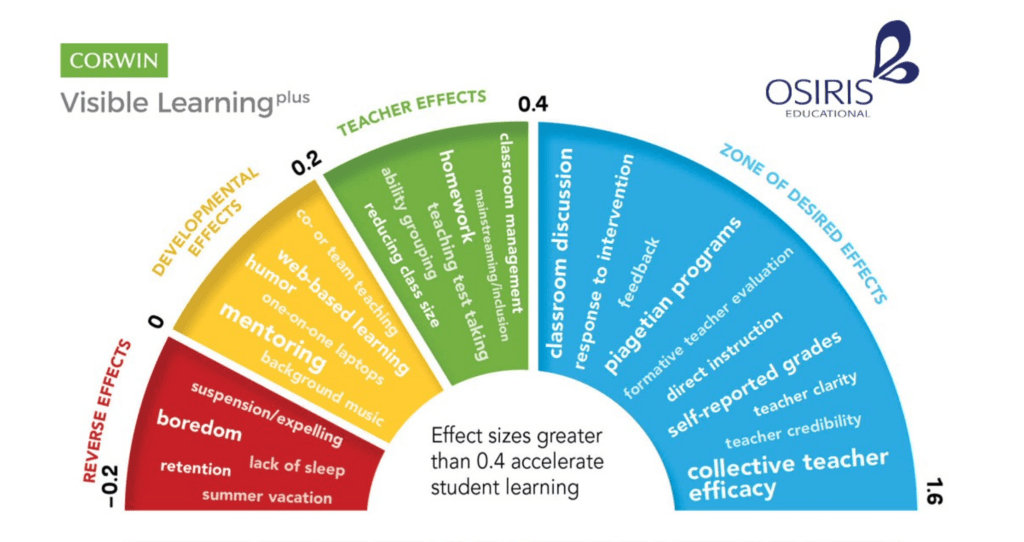
I gravitate towards the Zone of Desired Effects, specifically Teacher Clarity, (My responsibility- the HOW and WHY we are doing something. Learning Targets, Assessment, and Transparency) Self-Reported Grades, Formative Evaluation, and Feedback. Truly, that is the biggest game changer- teacher feedback. The combination of formative assessment and feedback to uncover and correct cognitive dissonance in students frames the journey toward meeting or exceeding learning targets.
There is a myriad of options for formative assessment, and we are doing it daily! We ask questions of students. We ask their why, their how, and how they reached that conclusion. Formative assessment places the increased expectation of feedback on both the teacher and student. These discussions are invaluable for student growth. How often has a student collected a piece of completed work, only to shove it into their backpack without reading the comments you wrote? How can anyone improve? Those that edit do the learning, and that is why you added feedback to this work. Now, think of the effect you can have by sitting down with that student and having a discussion of what you saw, what they created, their understanding of the current learning target for the lesson, misconceptions, and a path forward to correct the assignment using your feedback.
Or, the assignment can find its way into the depths of the backpack, where old gummy bears and forgotten bananas go to die until June. I feel that these discussions are vital for student growth, driving home the commitment to their development as a learner.
Questions: What I am often asked
Q: Do I stand up and lecture?
A: Sure! The caveat is that you have to include the students in the lecture itself. There are numerous Total Participation Strategies that provide opportunities for each student to participate. From PearDeck to graphic organizers, doodle notes, topic rankings, pause to reflect……the list goes on. Each one can transform your lecture into a learning strategy for students. Higher-need kiddos? Change the structure to differentiate for their learning styles.
Q: How will I know if students are learning?
A: Formative Assessment as a starter. Instead of waiting for the quiz to discover their misconception or missed understanding of a concept, catch it early with consistent, brief, but direct assessments. No grades- just for feedback and completion. You will catch those who are on pace to be assessment ready, and those that need remediation.
Q: If I tell them, then they are exposed to the information. How will they get it if I don’t explicitly tell them?
A: These classes live in a world full of information- right at their fingertips! We can create options to meet their learning styles that step out of the shadow of the lecture, notes, practice, quiz, repeat mode.
Q: “But, I have labs and projects to set up I definitely don’t want to have to put them up and take them down over and over.” How do I navigate things like student safety?
A: I create two options. 1. Station work that I can monitor as students work through. Choose four- six mini labs that support a specific concept for students to choose and work through at their own pace.
Option 2: Class labs (Chemistry, Anatomy, Biology, etc.) Lab day can be once a week. Students will have to have a certain assignment finished to participate with everyone, supporting those who are not “there yet. There are other methods. From a Science lens, these work well. Students that are not ready may not be able to participate and will have to utilize a different option. That little bit of FOMO may be enough to spur them forward.
Q: How do teachers begin the transition, while still balancing their daily work-life?
A: You have your curriculum all set! Changing your approach is a gradual process- one in which you investigate what you would like to try, and what may resonate with your students, and that seems easy to integrate while getting started. There will be some big swings and misses, but you control that rollout. There are numerous PD options, books, videos, and people to contact to help you get started. I have worked in three districts that underwent full transitions to student-centered learning approaches, and I am easy to reach through this blog!
My biggest piece of advice is to find what excites you about your subject because you are the expert. Then, experiment with a number of options, slowly at first. Take time to reflect on what worked, what flopped and ways to approach the same assignments differently. As always, whether they are hits or misses, always act like that was exactly what you wanted to happen! (Totally part of the lesson plan!)
 Mr. H's Not So Secret Classroom