
How do we know that our students are learning? Assessment is traditionally the way that educators determine if true learning has occurred. Whether formative or summative, we have all experienced a quiz, test, exam, or other similarly named assessment. While these practices have their place, I would question the authentic nature of how assessment is supposed to represent what students have learned and can demonstrate.
The effects of feedback depend more on its quality and substance than on its form or structure.
I still subscribe to the idea that feedback and grading are a conversation, NOT compensation. Honestly, students are shocked when I explain that I don’t really care what their grades are, rather, I am concerned with what they learned, their skill development, and HOW they grew as students to reach the final grade. I will often debate retakes, corrections, and formative feedback in lieu of grades. Too often, the logistics of student feedback, correction, and retakes will seem daunting- i.e. more work. Logistically, it can be a bit of a nightmare at times, but this process is vital for learning. I can edit assignments all day, every day. My question is this- who is learning during my editing? Students that edit are the ones that are learning! I can identify misconceptions, which can be addressed, reviewed, and practiced on the road to mastery. Without the opportunity for students to see this feedback, unlearn, re-learn, and then practice, I am not in a place where I can say that they have truly learned the concept. Let’s also be real about another thing- not all students will take the time to correct their work. That takes time because “grade compensation” has been ingrained in them for so long. School is “done to” them, without their participation, so they really have no idea how to be an integral part of learning. Compound this with the fact that I have ninth graders that arrive having done almost no, yes, you read that correctly, ALMOST ZERO assignments in middle school. The idea of a grade is neither attractive nor a deterrent.
How can this shift be made? What pulls in these slightly larger eighth graders?
There is no magic bullet for this one. In practice, I have found that beginning with an increase in formative assessments, coupled with student explanatory models begins to connect them to what learning could be. (Try this- ask your class who school is for, and watch their faces) Unlearning what has been ingrained for so long can be a slow and mildly cranky process for many. High fliers? They understand how to work the system, take a test, and receive compensation. It stopped being about learning a long time ago. For students that struggle, models offer a reprieve from large summative assessments but mean more thought, planning, and ultimately, work on their part.
So, where to begin? Teachers have students “report” back on topics that they assign all the time. I have done more book reports (back in the 1900s, as my youngest likes to remind me) and informative posters than I remember. Modeling is neither of those things.
I kindly request that you take what you know and gently set it aside.

Not “Teacher Modeling.”
While there is a definite need for teacher modeling, this is not that place. The teacher can introduce, explain, and model phenomena, but the actual model design will fall directly into the laps (and minds) of students. Real Talk- I have lit myself on fire, dropped and broken things, and used my share of band-aids. Why should I have all the fun? The attempt is to tease out what students currently know, challenge their thinking, and offer them the opportunity to demonstrate what they have learned in a way of their choosing.
Once students have been supplied with readings, notecatchers, labs, videos, inquiry experiences, discussions, formative assessment checkpoints, and opportunities to share their newly formed understandings, the pathway can be personalized for each student, or they can remain watching The Sage on the Stage. (your call) The end result should mirror the Learning Targets and proficiencies that were identified as the base for the topic.
Here is the twist! Students decide upon a way to model their understanding of the Proficiencies and Targets. Banished are what I call The Boring Big Three: The Paper, The Poster, and The Slide Show. Why? I have found that those three are not truly models. Rather, they are a copy-and-paste graveyard with items being chosen that have little special meaning or relevance to their understanding. Challenge them to follow their passions, channeling them to engage those parts of their lives that happen by choice outside of school. Why this approach? Because they have a choice! Based on my data, I have a much higher rate of completion and students that meet the standards identified as their targeted goal.
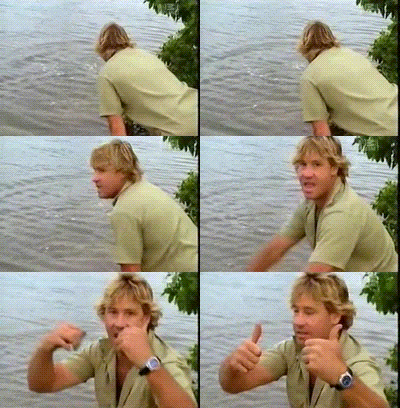
For example- when tasked to create an explanatory model that represents their understanding of the Electromagnetic Spectrum, I knew that one student was an aspiring animator. So, during our Model Consultation, I asked them if they could think of a connection between the passion for art, and the EM Spectrum. After a few moments, they asked if they could use two characters that explain how night vision goggles work. What I received was not only a model that met each of the Learning Targets, but a model that made extensions into nature (ex. bees, snakes) that mirror the collection of wavelengths to create images. This step beyond happened because they “got on a roll, wanting to have a real-life connection, so my characters seem real.” When we had a class Gallery Walk, the evident pride in their work sparked a lot of praise and deeper discussions into the topic that did not have to be prompted by me.
A few other sample products were experiments with different colored cloth to determine a recommendation for redesigned home and away sports uniforms. (All black is tough in the early Fall sun.) Students designed lab inquiries to generate data to support their hypothesis. This extension gave me the idea of having a class tackle the same investigation, adding the physiological connection, and creating a presentation for the school board.
From Static to Dynamic- Flat to 3D.
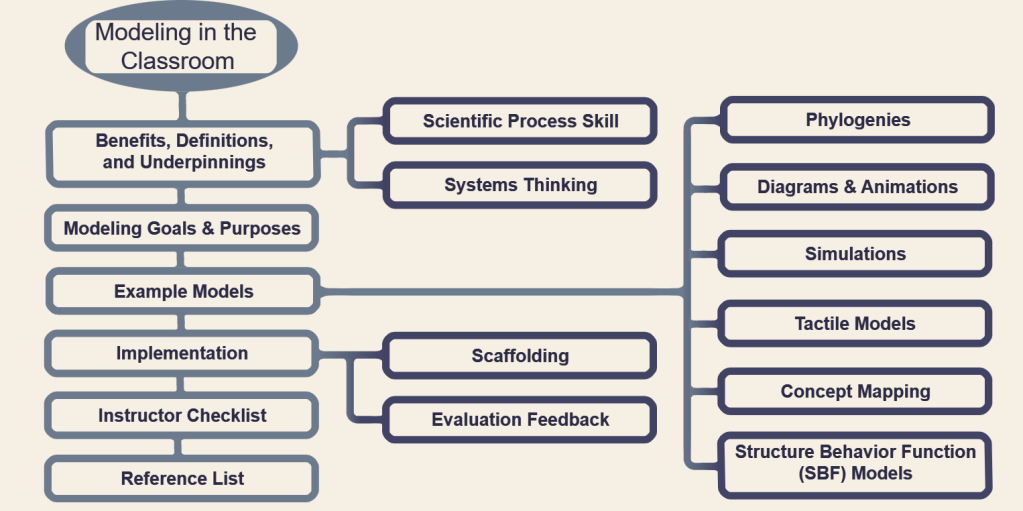
From: Wilson KJ, Long TM, Momsen JL, Bray Speth E. (2019) Evidence-Based Teaching Guide: Modeling in Classroom. CBE Life Science Education.
What is really in it for the teacher?
Ok. Let’s be honest for a second. It is less stressful, and arguably less of a circus to have all students completing the same assignment. I can create a lab inquiry that generates the same data and answers the same question. My question is what is more authentic? Does that one lab meet the needs of all students? Can it tell the same story? Possibly. That’s a fair point. But, for students that feel that school is just “done to them” without their input, which engenders a sense of connection, relationship, and classroom culture of taking risks?
Benefits:
Identifying misconceptions and providing insight. There is nowhere to hide when your job is to explain the details. You are free to circulate during class, individualized teaching for each student, run small groups, or meet students at a “help center” where they sit down to signal that they have a specific question. I have gone as far as having students sit, and roll a die. The number they roll is the number of hints I will give them toward model improvements. It is this simple game that they celebrate when a “five” or “six” shows up.
The authenticity of the assignment. We are always struggling for authenticity, and modeling can tap into student passions, creating a chance to demonstrate skills that are beyond the classroom walls. This is also an opportunity to deepen the relationship between student and teacher. These connections are invaluable, paying dividends when the inevitable rough patch hits.
For example, a student modeled stellar nucleosynthesis by creating an animated model/ video of the process. In diving deeper, I discovered that this student adores animation, and hopes to design movie and video game animations post-high school. Not only did this give me insight into the student’s passions, but allowed me to share some summer animating opportunities that I knew about at a college that offers this as a major. Through this model, I could make a student and home connection that I may not have made. Models can create pathways through which students feel seen, heard, and valued in their learning communities.
You are providing the opportunity for students to take ownership of their learning through the co-design of the curriculum. You set the story, the baseline Learning Targets, and the initial assessment criteria. As students develop their ideas/ plans of action, opportunities open up to discuss/ have them design rubrics to peer and self-assess. There is a collective determination around what qualifies as a project that approaches, meets, or exceeds the standards that you initially set as the target for student understanding.
What is the benefit for students? Models provide students the chance to confront their true understanding. Often, students will tell me that they have “got it” and are good to move on. Modeling exposes the depth of thinking and attention to conceptual details that students may not yet thoroughly grasp.
Where to start? I usually begin discussions of modeling with exemplars and examples. Seeing makes the concept of modeling real, often shaking off the specter of The Boring Big Three.
Start Here: What do students think it means for any project to be:
Accurate?
Containing the Big Details?
Colorful?
Detailed?
Explained?
This often can be designed and displayed as an anchor chart for modeling. It can be added to at any time and will evolve from modeling session to modeling session.
This process requires you to put some learning in the hands of the students. Newsflash: they actually WANT this!! They may complain at first because this type of cohesive thinking is a challenge beyond a question on a worksheet. Don’t get me wrong, this type of learning is messy- but true understanding is dynamic. Step back and look at your own practice. Where can students take the lead to demonstrate to you that they know? How much of a role do you want them to have in their own learning? What deeper dives can be taken when they express their passions?
How would you like to begin to evolve your practice?
 Mr. H's Not So Secret Classroom