
It is dinner time. The one chance each day to sit down with my children and ask them about their day. It is time for “highlights/ lowlights.”
“What was the best part of your day?”
“I did well on my formative test. “(Ugh! “Test” Hair stands up on the back of neck. Bites tongue.)
“That is great. Good to check in on your understanding of the concept so far in the proficiency.”
“Yea! Since it is worth 10% of my grade, I was happy.”

“Reallllly? Why assign a grade? Why do you think it is included as part of your grade?”
“Because that way we will try.”
After I stepped away from that “amygdala moment,” I began to question my approach to formative assessments. What was the purpose? Why give them at all? What is the role for any assessment?
Over the past 23 years as a classroom educator, I have discovered a few things.
- Students often need a break, they do not need to go to the bathroom.
- Students need a sense of value and belonging in the classroom.
- I have never written an assessment that accurately represents what a student understands and can demonstrate.
To cut myself some slack- I have tried. Valiant efforts have been put forth to slay the “assessment dragon.” Research into the types of questions, formats, online vs. paper, image selection, diagrams, wording- all with the hope of finding that “spirit bear” of assessment.

With that sobering knowledge in hand, it was time to unlearn my old (should I say nostalgic) ways of assessment. Flipping the script to answer questions like-
- How to reduce test anxiety?
- What should assessments demonstrate?
- What are alternative ways for students to show understanding?
- If I am asking that their learning be dynamic, why can’t assessments be dynamic as well?
- What does dynamic look like?
Learning is messy, but understanding is dynamic. One morning, out for a run (I refer to it as “chasing headlamps.”) It occurred to me that a student should always be able to model identified learning targets, BUT it should not matter HOW they express this understanding. Along the way, there should be low stakes, mastery-based opportunities for students to check their understanding. (No, not always on paper.) There is little anxiety when you know that any assessment does the following:
- Focuses on mastery. The practice can be taken as many times as necessary before moving to the next task. This follows the same model as any video game or athletic team. Practice until you have it right. The achievement IS the reward.
- Is low stakes. The assessment is not a punishment, but an opportunity that does not count towards their final assessment. (Habits of Work only.)
- Emphasizes the importance of mastery learning, not earning a grade.
- It can be fun! (“incredulous hush…”)
Summatives are another post entirely. Let me stress that summative assessments are never going to be what you want them to be without framing the journey with formatives. Nope. There is an entire layer of deeper understanding that will be lost without formatives.
Formatives, for my classes, are broken into two categories, demonstration and “rapid play” assessments.
Demonstration– These can be longer demonstrations, on paper, diagrammed, written, with an opportunity for teacher and peer feedback. Feedback is vital for any formative, but face to face feedback can be very powerful for both teacher and student. Demonstrations can be built quickly, or completed analogously.
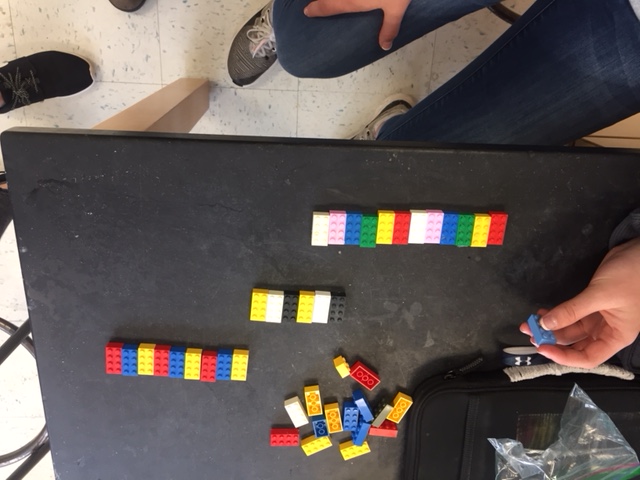
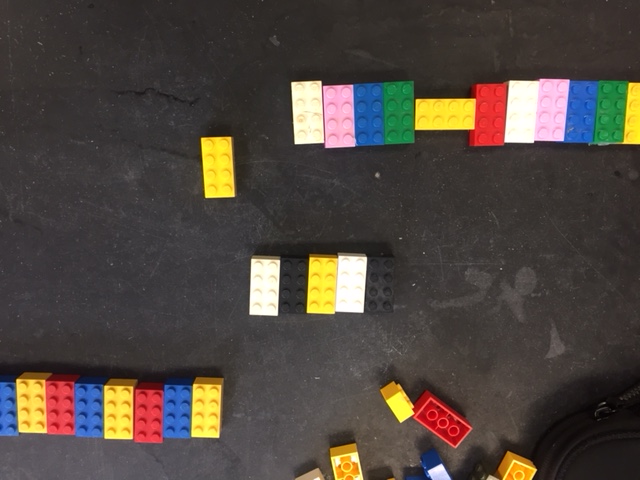
Ex. From our proficiency regarding mutuations- students are instructed to ask me for the formative. What they receive is a bag of Legos. Their task is to demonstrate three types of mutations using these toys. When they think they have it, I will sit down and let them demonstrate. We then reference the Learning Target for types of mutations, and I ask them to self assess. Then, I provide feedback. This takes about five minutes, but we both leave this time with a clear understanding of where that student is in the pursuit of the proficiency. If they are all set, the student moves into the next phase of the proficiency playlist. If we identify deficiencies, they go back to review previous Performance Tasks, and try again. And again. And again. The goal? The figure it out- NOT the grade.
Formatives can be quick and simple.
Make me a meme to identify the main ideas of a Learning Target.
Using this apple, explain how it resembles the internal structure of the Earth.
Create a time lapse for Plate Tectonics using these three crackers, then email it to me. Here is a bag of clay, create a model showing distances in space with the interval being light years.
Create a time lapse for Plate Tectonics using these three crackers, then email it to me.
Here is a bag of clay, create a model showing distances in space with the interval being light years.
Using this apple, explain how it resembles the internal structure of the Earth. Create a time lapse for Plate Tectonics using these three crackers, then email it to me. Here is a bag of clay, create a model showing distances in space with the interval being light years.

“Rapid Play” – formatives focus on the transferable skills that I want students to develop. Students must be an active participant in developing these skills, and should become well versed in the language across the curriculum. To accomplish these, I play “cocktail party,” walking between groups, pairs, or sitting with individual students. I may ask the group to pause, and assess their current level of collaboration. If students are working on a lab design, I can ask how well they feel that they are thinking critically. This is usually 1-4, just as the summatives are assessed, and then followed up with an explanation of why they self assessed this way. I reserve my own observations and assessment until the end of their explanation. Often, they are much more critical, and need to be shown the bright spots. I “catch” them doing the right things, or redirect students that are off task. It is often anecdotal, but there are days in which I record their responses, which will be saved for comparisons later in the unit. The goal is always to bring attention to development of knowledge and skills. Formatives, in my own practice, have made me a better educator, through framing the journey towards proficiency for all students.
 Mr. H's Not So Secret Classroom